









Every organization that wants to scale its operations, make faster decisions, and stay adaptable in a changing market needs a structured way of organizing its processes, data, and strategy. This is exactly the gap that the Trigrespinx Framework fills. It is a layered architectural model designed to help businesses connect strategic thinking with day-to-day execution, while keeping data flow, decision-making, and continuous optimization tightly integrated.
This guide walks through the complete Trigrespinx Framework architecture — its layers, design principles, lifecycle, customization options, maturity stages, common mistakes, and future direction. By the end, you will understand not just what the Trigrespinx Framework is, but how to apply it effectively inside your own organization.
What Is the Trigrespinx Framework Architecture?
The Trigrespinx Framework architecture refers to the underlying structural design that governs how an organization’s strategy, operations, data, and decisions interact with one another. Rather than treating each business function as an isolated silo, the framework connects them through defined layers that pass information back and forth in a controlled, predictable way.
The result is a system where strategic goals directly influence operational execution, and where real-world performance data feeds back into strategic planning. This closes the loop between intention and outcome, which is the core value the Trigrespinx Framework delivers.
Why Framework Architecture Matters
A clear architecture matters because unstructured growth eventually creates friction. Teams start duplicating effort, decisions get made on incomplete information, and feedback from operations rarely makes its way back to leadership.
A well-designed framework architecture, like the one behind Trigrespinx, solves these problems by giving every layer of the organization a defined role and a defined channel of communication with the layers around it. As a result, bottlenecks shrink, decisions become faster and more accurate, and processes scale without losing quality or consistency.
Core Objectives of the Trigrespinx Framework
The Trigrespinx Framework is built around four central objectives:
- Aligning strategic intent with daily execution
- Ensuring data moves cleanly between systems and teams
- Supporting faster, more accurate decision-making
- Creating a continuous feedback mechanism so the organization improves instead of repeating mistakes
These objectives shape every layer of the framework, which is explained in detail below.
The Architecture of the Trigrespinx Framework
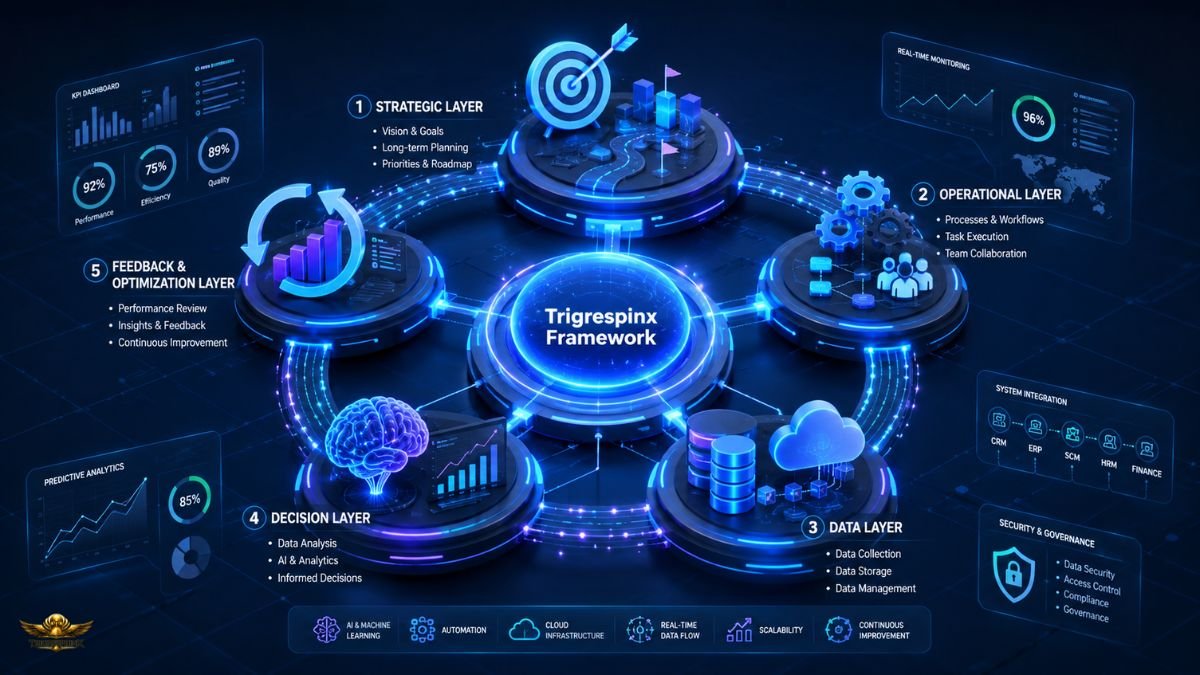
The Trigrespinx Framework is composed of five interconnected layers. Each layer has a distinct responsibility, but none of them function well in isolation — the architecture only works when the layers exchange information continuously.
| Layer | Primary Role | Key Output |
| Strategic Layer | Defines vision, goals, and long-term direction | Strategic objectives and priorities |
| Operational Layer | Converts strategy into daily processes and workflows | Executed tasks and operational output |
| Data Layer | Collects, organizes, and structures information | Clean, usable data sets |
| Decision Layer | Analyzes data to guide choices | Informed decisions and action plans |
| Feedback & Optimization Layer | Reviews outcomes and refines the system | Continuous improvements |
Strategic Layer
The strategic layer sits at the top of the Trigrespinx Framework and is responsible for setting the direction of the entire organization. It defines long-term goals, market positioning, and the priorities that every other layer will eventually work toward. Without a clear strategic layer, operational teams end up executing tasks with no real sense of purpose or measurable outcome.
Operational Layer
The operational layer translates strategy into action. This is where day-to-day workflows, task management, and resource allocation happen. It is the layer most people interact with directly, since it governs how work gets done, how teams collaborate, and how efficiently resources are used to meet strategic goals.
Data Layer
The data layer acts as the framework’s information backbone. It gathers data from operational activities, customer interactions, and external sources, then structures it so it can be analyzed and trusted. A weak data layer undermines every other part of the architecture, since decisions and optimizations are only as good as the data behind them.
Decision Layer
The decision layer takes structured data from the layer below and uses it to guide choices — whether that means adjusting a workflow, reallocating a budget, or shifting strategic priorities. This is where analytics, judgment, and business logic come together to turn raw information into meaningful action.
Feedback & Optimization Layer
The final layer closes the loop. It reviews the outcomes of decisions and operational execution, identifies what worked and what didn’t, and feeds those insights back into the strategic and operational layers. This is what keeps the Trigrespinx Framework from becoming static — it is designed to learn and adapt over time.
How Information Flows Through the Trigrespinx Framework
Information in the Trigrespinx Framework moves in a continuous cycle rather than a straight line. Strategic goals flow down into operational plans. Operational activity generates data. That data is analyzed at the decision layer. The resulting decisions produce outcomes that are reviewed at the feedback layer. Finally, insights from that review travel back up to the strategic layer, informing the next round of planning.
This circular flow is what makes the Trigrespinx Framework architecture resilient — no single layer operates on outdated or disconnected information for long.
How Framework Components Work Together
The strength of the Trigrespinx Framework lies in how tightly its components are woven together. The strategic layer cannot succeed without accurate data from below. The operational layer cannot function efficiently without clear direction from above. The decision layer depends entirely on both structured data and defined strategic priorities to produce meaningful guidance.
When these components communicate well, the organization behaves less like a collection of departments and more like a single coordinated system.
The Trigrespinx Framework Lifecycle
The Trigrespinx Framework operates through a repeating lifecycle that keeps the architecture active and relevant.
Planning
Planning is where strategic goals are translated into specific, measurable objectives, and where the roadmap for execution is created.
Execution
Execution is the operational phase, where teams carry out planned activities, allocate resources, and manage day-to-day workflows.
Monitoring
Monitoring involves tracking performance data as it is generated, checking it against expected outcomes, and flagging deviations early.
Optimization
Optimization improves processes, decisions, and future planning.
Design Principles Behind the Trigrespinx Framework
Scalability
The Trigrespinx Framework is built to handle growth without requiring a complete redesign, allowing new teams, processes, or data sources to be added smoothly.
Flexibility
The framework adapts to different industries, business sizes, and operating models without losing its core structure.
Modularity
Each layer functions as an independent module, meaning it can be upgraded or adjusted without disrupting the rest of the system.
Interoperability
The layers are designed to communicate seamlessly with existing tools, platforms, and data systems already in use within an organization.
Continuous Improvement
Because of the feedback loop built into the architecture, the Trigrespinx Framework is never a finished product — it continuously evolves based on real performance data.
How to Customize the Trigrespinx Framework
Small Businesses
Smaller organizations typically use a simplified version of the framework, focusing on lightweight operational and data layers that don’t require heavy infrastructure.
Medium Businesses
Medium-sized businesses strengthen their data and decision layers with advanced analytics to manage growing complexity.
Enterprise Organizations
Enterprises often build out every layer fully, with dedicated teams managing strategy, operations, data governance, and decision analytics separately, all connected through structured feedback mechanisms.
Framework Maturity Levels
Beginner Stage
At this stage, the organization has basic versions of each layer in place but limited integration between them.
Growth Stage
Here, data flow becomes more structured, feedback loops start functioning consistently, and decision-making becomes more evidence-based.
Advanced Stage
At the advanced stage, all five layers of the Trigrespinx Framework operate in close coordination, supported by automation and analytics that make the entire system highly responsive.
Common Framework Design Mistakes
Poor Layer Integration
Treating each layer as a separate silo instead of a connected system is one of the most common architectural failures.
Weak Data Flow
If data isn’t collected or structured properly, every decision built on top of it becomes unreliable.
Lack of Feedback Loops
Without a functioning feedback layer, the organization repeats the same mistakes instead of learning from past outcomes.
Over-Complex Architecture
Adding unnecessary layers or overly rigid processes can slow the system down rather than improve it, especially in smaller organizations.
How to Evaluate Trigrespinx Framework Performance
Architecture Efficiency
This measures how smoothly information and tasks move between layers without unnecessary delays or duplication.
Decision Accuracy
This looks at how often decisions made through the framework lead to the intended outcomes.
Process Scalability
This evaluates whether the framework can handle increased workload or complexity without breaking down.
System Adaptability
This measures how quickly the framework can adjust when strategic priorities or market conditions change.
Advanced Framework Optimization Techniques
AI-Assisted Decision Support
Integrating AI tools into the decision layer helps process larger volumes of data and surface patterns that might be missed manually.
Workflow Automation
Automating repetitive operational tasks frees up teams to focus on higher-value work and reduces the chance of human error.
Predictive Analytics
Using historical data to forecast future trends allows the strategic layer to plan proactively rather than reactively.
Real-Time Monitoring
Live dashboards and monitoring tools shorten the feedback cycle, allowing issues to be caught and corrected almost immediately.
Future Evolution of the Trigrespinx Framework
AI-Native Frameworks
As organizations adopt distributed systems, the framework’s layers operate natively across cloud environments for greater flexibility.
Intelligent Automation
Automation will likely move beyond simple task execution into adaptive workflows that adjust themselves based on live data.
Cloud-Native Architecture
As organizations shift further toward distributed systems, the framework’s layers are expected to operate natively across cloud environments for greater flexibility.
Autonomous Decision Systems
Over time, parts of the decision layer may operate with increasing autonomy, using predictive models to make lower-risk decisions without direct human input.
Best Practices for Building a Strong Trigrespinx Framework
Building a strong version of the Trigrespinx Framework starts with getting the data layer right, since every other layer depends on clean, reliable information. From there, keep communication channels between layers well-defined rather than informal, so strategic priorities actually reach the operational teams executing them.
Build feedback loops in from day one instead of adding them later. Review the framework regularly so it doesn’t become outdated as the business grows. Finally, tailor the architecture to your actual business size and goals — a setup that’s too heavy for a small team is just as problematic as one that’s too lightweight for an enterprise.
Final Thoughts
The Trigrespinx Framework architecture offers a structured, layered approach to connecting strategy, operations, data, and decision-making into one continuously improving system. Its strength comes from the feedback loop that ties every layer back to the ones around it, ensuring the organization doesn’t just execute plans but actually learns from them.
Whether applied by a small business or a large enterprise, the Trigrespinx Framework’s modular design makes it adaptable enough to grow alongside the organization using it.
FAQs
What is the Trigrespinx Framework architecture?
The Trigrespinx Framework is a structured system that connects strategy, operations, data, decisions, and continuous improvement into one integrated architecture.
What are the five layers of the Trigrespinx Framework?
The five core layers are the Strategic Layer, Operational Layer, Data Layer, Decision Layer, and Feedback & Optimization Layer.
How does the Trigrespinx Framework process information?
Information flows from strategy to execution, data, decisions, and feedback.
Can the Trigrespinx Framework be customized?
Yes. It scales across industries, business sizes, and organizational needs.
How is Trigrespinx Framework performance measured?
Performance is measured through architecture efficiency, decision accuracy, process scalability, and system adaptability.
What is the future of the Trigrespinx Framework?
The framework is evolving toward AI-native design, intelligent automation, cloud-native infrastructure, and increasingly autonomous decision-making.



6 thoughts on “Trigrespinx Framework Architecture: Layers, Structure & Design”