










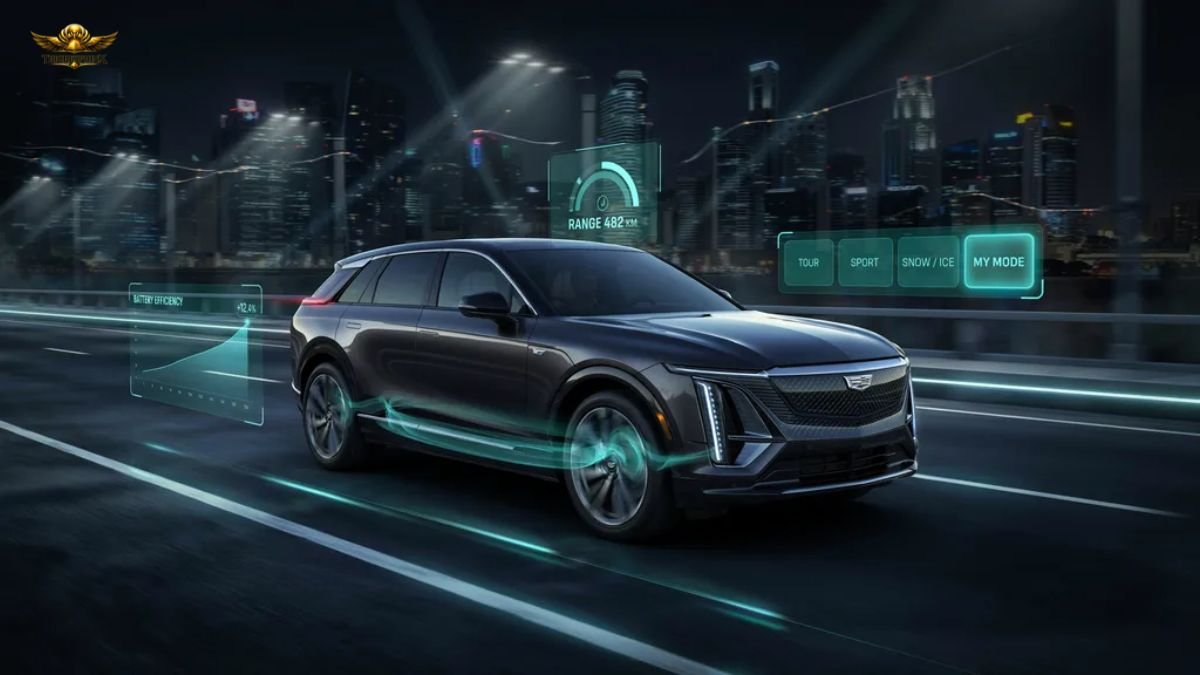
The Cadillac LYRIQ offers multiple driving modes engineered to balance performance, comfort, and efficiency in a single electric vehicle. One question almost every LYRIQ owner eventually asks is simple but important: does switching driving modes actually change battery usage and real-world driving range on a single charge?
Yes. Driving modes influence energy consumption by optimizing power delivery and vehicle response, while the battery’s capacity remains unchanged.. Instead, each mode adjusts throttle response, power delivery, and climate prioritization, while the LYRIQ’s intelligent battery management and thermal control systems work in the background to keep overall efficiency as consistent as possible. The result is a system where mode selection, driving behavior, and battery management all interact to shape the miles you ultimately get from a charge.
This comprehensive guide breaks down exactly how each Cadillac LYRIQ driving mode affects battery usage, driving range, energy efficiency, regenerative braking, and overall performance so you can choose the right mode for every driving situation, from daily commuting to long-distance highway trips.
Understanding Cadillac LYRIQ Driving Modes
The LYRIQ is built around a set of selectable drive modes that adjust throttle mapping, steering weight, suspension behavior (on equipped trims), and climate prioritization. Rather than being purely cosmetic settings, each mode changes how the vehicle’s software distributes power between the front and rear motors on all-wheel-drive versions, and how aggressively it responds to pedal input.
Tour Mode
Tour Mode is the default, balanced setting most owners drive in day to day. It smooths out throttle response, keeps the suspension in its most comfortable calibration, and prioritizes a relaxed, linear acceleration curve. Because the powertrain isn’t chasing peak output, Tour Mode tends to be the most predictable setting for everyday commuting and errands.
Sport Mode
Sport Mode sharpens throttle sensitivity so the LYRIQ responds faster to even light pedal inputs, tightens steering feel, and allows quicker torque delivery from both motors. This mode is designed for spirited driving, merging onto highways, or simply enjoying the instant torque that electric motors are known for.
Snow/Ice Mode
Snow/Ice Mode softens throttle response dramatically and adjusts traction control thresholds so the vehicle doesn’t send too much torque to the wheels on low-grip surfaces. It’s built for safety and control rather than speed, and it noticeably changes how the car accelerates from a stop.
My Mode
My Mode lets owners create a personalized blend of throttle response, steering feel, and climate settings. Many drivers use this to combine Sport-like throttle mapping with a more efficiency-focused climate setup, effectively customizing the trade-off between performance and range to their own preferences.
How Driving Modes Change Vehicle Performance
Across all four modes, the core battery pack itself never changes. What changes is how quickly the car is willing to draw current from that pack and how the electric motors are asked to behave. This distinction matters a lot when evaluating range, because the difference in efficiency comes from driving behavior enabled by the mode, not from the mode altering the physical battery.
Do Driving Modes Change Battery Usage or Driving Range?
Do Driving Modes Change Battery Capacity?
No driving mode increases or decreases the usable capacity of the LYRIQ’s battery pack. The battery’s usable kilowatt-hour (kWh) capacity remains the same regardless of the selected driving mode, as drive modes influence energy consumption rather than the battery’s actual capacity. What driving modes influence is the rate of energy discharge, which indirectly affects how many miles you get from that fixed capacity.
How Driving Modes Affect Energy Consumption
Energy consumption in an EV is primarily a function of how much current the motor draws, how efficiently regenerative braking recovers energy, and how much power auxiliary systems like climate control consume. Driving mode touches all three of these areas, which is why the perceived range can shift by a noticeable margin between Tour and Sport driving.
Throttle Response and Acceleration
Sport Mode’s quicker throttle mapping encourages harder acceleration, and harder acceleration draws more current from the battery than gradual, steady inputs. Even if a driver’s overall speed pattern is similar, the more aggressive power delivery in Sport Mode tends to consume more energy per mile than the smoother delivery in Tour Mode.
Regenerative Braking Differences
The LYRIQ’s regenerative braking behavior can vary slightly depending on the mode and the driver-selected regen level, and stronger regen settings paired with one-pedal driving recover more kinetic energy back into the battery. This recovered energy directly offsets consumption, which is why regen habits often matter more than the mode itself.
Climate Control and HVAC Energy Usage
Heating and cooling draw a significant amount of power in any EV, and this consumption happens independently of which drive mode is active. However, My Mode allows drivers to dial back HVAC intensity while keeping a sportier throttle feel, showing that climate settings and drive mode are separate levers that both affect range.
Performance vs Efficiency Trade-Offs
Ultimately, every drive mode represents a different point on the same performance-versus-efficiency curve. Tour Mode prioritizes efficiency for everyday driving, Sport Mode maximizes performance with higher energy consumption, while Snow/Ice Mode focuses on traction and stability, often delivering efficiency similar to Tour Mode through smoother power delivery. Tour Mode because acceleration is deliberately restrained.
Cadillac LYRIQ Driving Modes Compared
| Driving Mode | Throttle Response | Typical Efficiency Impact | Best Use Case |
| Tour | Smooth, linear | Baseline efficiency | Daily commuting, mixed driving |
| Sport | Sharp, immediate | Lower efficiency, higher consumption | Highway merging, spirited driving |
| Snow/Ice | Muted, gradual | Similar to or slightly below Tour | Low-traction winter roads |
| My Mode | Customizable | Depends on configuration | Owners who want a personalized balance |
Tour Mode vs Sport Mode
Tour Mode typically delivers better real-world efficiency than Sport Mode because its smoother throttle response reduces aggressive acceleration, resulting in lower energy consumption and improved driving range. Sport Mode isn’t inefficient by design, but the driving style it invites is what pulls range down.
Tour Mode vs My Mode
My Mode can match or even slightly exceed Tour Mode’s efficiency if a driver configures it with gentle throttle mapping and reduced climate output. This flexibility makes My Mode appealing to owners who want fine control over their energy usage without sacrificing every performance characteristic.
Sport Mode vs Snow/Ice Mode
These two modes sit at opposite ends of the throttle-response spectrum. Sport Mode maximizes responsiveness while Snow/Ice Mode intentionally dampens it, which means Snow/Ice Mode often achieves better efficiency purely as a side effect of its cautious power delivery.
Which Driving Mode Delivers the Best Efficiency?
Tour Mode remains the most reliable choice for maximizing range in typical conditions, with My Mode as a close alternative for drivers willing to fine-tune their own settings.
Real-World Range Differences Across Driving Modes
City Driving Performance
In stop-and-go city conditions, the gap between modes narrows because frequent braking allows regenerative braking to recover energy regardless of which mode is active. Owners often report only a small difference in city range between Tour and Sport driving.
Highway Driving Efficiency
At sustained highway speeds, aerodynamic drag becomes the dominant factor in energy use, which tends to flatten differences between drive modes. Here, speed and wind resistance matter far more than whether the car is in Tour or Sport.
Mixed Driving Conditions
For a typical mix of city streets and highway stretches, Tour Mode tends to outperform Sport Mode by a modest but measurable margin, largely due to reduced aggressive acceleration during the city portions of the drive.
Real-World Owner Experiences
Many LYRIQ owners describe noticing a few percentage points of difference in projected range when comparing Tour and Sport over the same route, reinforcing that mode selection has a real but moderate influence rather than a dramatic one.
Regenerative Braking and One-Pedal Driving
How Regenerative Braking Extends Driving Range
Regenerative braking captures kinetic energy that would otherwise be lost as heat during braking and feeds it back into the battery. This process is one of the most effective ways to extend range without changing driving mode at all.
One-Pedal Driving and Energy Recovery
When one-pedal driving is engaged, lifting off the accelerator triggers stronger regenerative braking, allowing drivers to slow down and recover energy simultaneously. Drivers who master this technique often see a tangible improvement in overall efficiency.
Does Driving Mode Affect Regenerative Braking?
While the regen level itself is typically adjusted independently through paddle controls or menu settings, certain drive modes pair more naturally with stronger regen calibration, meaning the two systems work together rather than in isolation.
Key Factors That Affect Cadillac LYRIQ Range More Than Driving Modes
Driving Style and Acceleration Habits
Consistent, gentle acceleration has a bigger impact on range than the drive mode label itself, since a smooth driver in Sport Mode can still outperform an aggressive driver in Tour Mode.
Highway Speed and Aerodynamic Drag
As speed increases, aerodynamic drag becomes the biggest factor reducing EV range, outweighing the impact of driving modes.
Outside Temperature and Weather Conditions
Cold weather forces the battery management system to work harder and increases cabin heating demand, which can reduce range far more significantly than switching between Tour and Sport.
Battery Thermal Management
The LYRIQ actively manages battery temperature to protect longevity and performance, and this background energy use happens regardless of drive mode selection.
Heating and Air Conditioning Usage
Running the cabin heater on a cold day can consume more energy than the difference between any two drive modes combined, making climate settings one of the biggest range variables overall.
Tire Pressure and Wheel Size
Underinflated tires increase rolling resistance and quietly reduce range over time, while larger wheel packages typically trade a bit of efficiency for styling and handling.
Vehicle Load and Cargo Weight
Extra passengers or cargo add mass that the motors must work harder to move, subtly reducing range independent of drive mode.
Road Conditions and Terrain
Hilly terrain and rough road surfaces increase energy demand, while regenerative braking on downhill stretches can partially offset the climbing cost.
Charging Habits and Battery Health
Consistently charging to very high percentages or letting the battery run frequently low can affect long-term battery health, which in turn influences the range available regardless of which drive mode is used.
Best Driving Mode for Every Situation
Daily commuting scenarios are best handled with Tour Mode, as it provides the strongest balance of comfort and efficiency. On long-distance highway drives, Tour Mode combined with steady, moderate speeds delivers the most consistent and predictable range. When performance is the priority, Sport Mode unlocks the LYRIQ’s full responsiveness, though it comes with a noticeable efficiency trade-off. In snowy or slippery conditions, Snow/Ice Mode should take priority over range concerns to maintain maximum safety and stability. Drivers who focus on maximizing range can achieve the best results by using a customized My Mode setup along with smooth, gentle acceleration habits.
Tips to Maximize Cadillac LYRIQ Battery Range
Owners looking to stretch every mile should focus on smooth, gradual acceleration instead of quick bursts of speed. Using regenerative braking and one-pedal driving whenever possible helps recover energy that would otherwise be wasted. Preconditioning the battery and cabin while still plugged in reduces the energy draw once driving begins. Keeping tires at the manufacturer-recommended pressure minimizes rolling resistance, and limiting unnecessary climate control use, such as relying on heated seats instead of full cabin heating, can meaningfully extend range on shorter trips.
Common Mistakes That Reduce EV Range
Frequent hard acceleration remains one of the most common habits that quietly drains range faster than expected. Driving at consistently high speeds on the highway compounds aerodynamic losses. Ignoring tire maintenance allows rolling resistance to creep up unnoticed. Overusing heating or air conditioning, especially at maximum settings, pulls disproportionate power from the battery. Carrying unnecessary weight in the trunk or cabin adds a small but constant efficiency penalty on every trip.
Looking Ahead: Software and Future Updates
Cadillac continues to improve the LYRIQ through over-the-air software updates that optimize throttle response, regenerative braking, and battery management.As these updates roll out, the efficiency gap between driving modes may continue to narrow, and owners should keep an eye on release notes for any changes that specifically mention range optimization or drive mode tuning.
FAQs
Which Cadillac LYRIQ Driving Mode Is Best for Maximum Range?
Tour Mode generally offers the best real-world range due to its smoother throttle response, with a well-configured My Mode as a close second.
Does Sport Mode Reduce Battery Range?
Sport Mode itself doesn’t reduce battery capacity, but the aggressive acceleration it encourages typically results in higher energy consumption and reduced range compared to Tour Mode.
Does One-Pedal Driving Increase Driving Efficiency?
Yes, one-pedal driving improves efficiency by recovering more kinetic energy through regenerative braking during deceleration.
Can Frequently Switching Driving Modes Affect Battery Health?
Switching modes does not directly harm battery health, since the underlying battery chemistry and capacity remain unaffected by mode selection.
What Factors Have the Biggest Impact on Cadillac LYRIQ Range?
Driving speed, outside temperature, climate control usage, and acceleration habits typically influence range more heavily than the selected drive mode.
Final Verdict
Driving modes on the Cadillac LYRIQ do influence battery usage and range, but the effect comes from the driving behavior each mode encourages rather than any change to the battery itself. Tour Mode remains the most efficient everyday choice, Sport Mode trades range for responsiveness, and Snow/Ice Mode prioritizes safety over both. For owners who want the best of every world, a thoughtfully configured My Mode combined with smart habits like gentle acceleration, effective regenerative braking, and mindful climate control use will always deliver the strongest real-world range.