










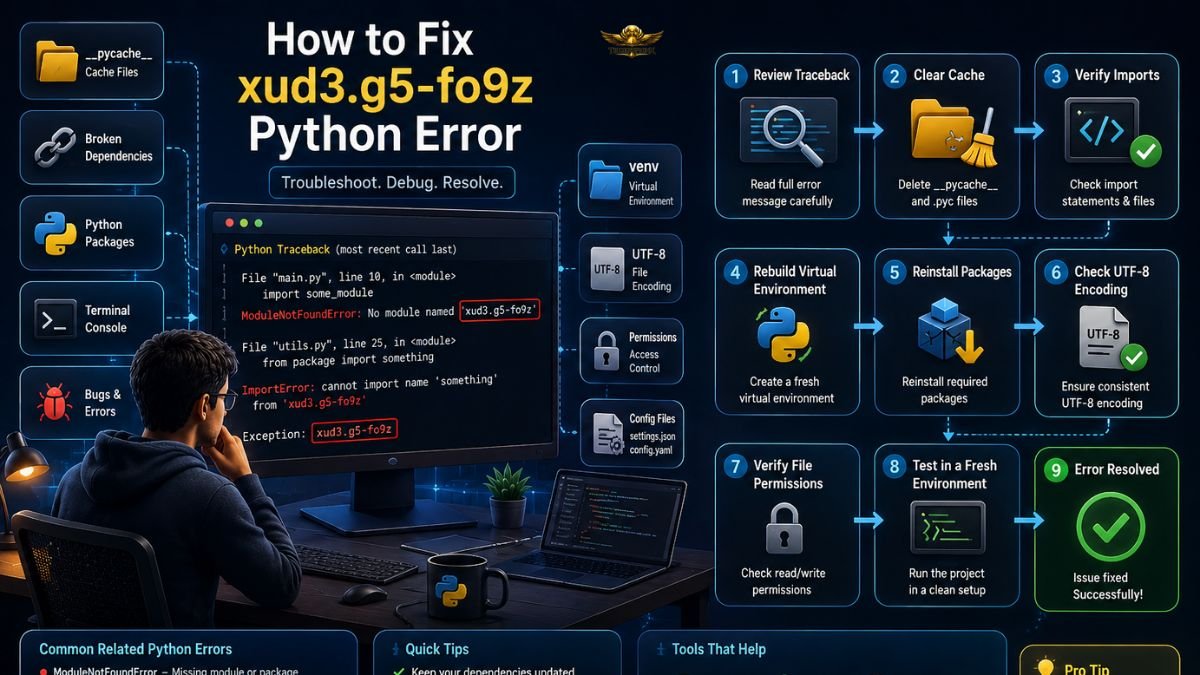
If you’ve encountered xud3.g5-fo9z while working with Python, you’re probably wondering whether it’s a real module, a software component, or a sign that something is wrong with your environment. The identifier usually appears inside a traceback, log file, cached object, or generated configuration, making it look more mysterious than it actually is.
In reality, xud3.g5-fo9z is not an official Python package or built-in module. In most situations, it represents a temporary identifier generated by software rather than something developers intentionally install. The real problem usually lies elsewhere, such as corrupted cache files, dependency conflicts, virtual environment issues, broken imports, or damaged project files.
This guide explains what the identifier means, why it appears, how to identify its real source, and the most effective ways to fix it safely.
Quick Bio
| Topic | Details |
|---|---|
| Error Name | xud3.g5-fo9z Python Error |
| Error Type | Temporary internal identifier (not an official Python error) |
| Main Cause | Cache corruption, dependency conflicts, broken imports, or virtual environment issues |
| Common Errors | ModuleNotFoundError, ImportError, AttributeError, KeyError, UnicodeDecodeError |
| Difficulty | Beginner to Intermediate |
| Primary Fix | Review traceback, clear __pycache__, verify imports, rebuild virtual environment |
| Affected Systems | Windows, macOS, Linux |
| Is It Malware? | No, not by itself |
| Prevention | Use virtual environments, keep dependencies updated, use UTF-8 encoding, avoid interrupted installations |
| Best Practice | Focus on the actual exception in the traceback, not the random identifier |
What Is the xud3.g5-fo9z Python Error?
The xud3.g5-fo9z Python error isn’t an official error type defined by Python. Instead, it is an unusual identifier that sometimes appears alongside standard exceptions such as ModuleNotFoundError, ImportError, AttributeError, KeyError, or UnicodeDecodeError.
Python itself doesn’t generate readable names for every temporary object used during execution.Development frameworks often assign random identifiers to ensure unique internal references.Those identifiers normally remain hidden from developers.
When something goes wrong, however, these temporary names occasionally appear inside stack traces, configuration files, cache directories, or application logs. Because the identifier looks random, many developers incorrectly assume it is malware or an unknown Python package when it is usually neither.
Is xud3.g5-fo9z a Real Python Module or Package?
No.
There is no official Python package named xud3.g5-fo9z, and it isn’t part of the Python Standard Library. It also isn’t recognized as an official package on the Python Package Index (PyPI).
If your traceback references this identifier during an import, Python is usually pointing to one of several internal problems rather than requesting an actual package. Common possibilities include:
- A corrupted cache file
- A temporary build artifact
- An automatically generated configuration key
- A renamed project file
- A broken dependency reference
- A damaged virtual environment
This distinction is important because many developers waste time searching for a package that simply doesn’t exist instead of investigating the environment that produced the identifier.
Why Does Python Generate Random Identifiers Like xud3.g5-fo9z?
Random-looking names are completely normal in modern software development.
Large Python applications constantly create temporary objects, cache files, hashed filenames, build artifacts, session identifiers, and unique configuration keys. These automatically generated names help software distinguish one object from another without creating conflicts.
For example, build pipelines often assign unique identifiers to compiled resources, testing frameworks generate isolated execution objects, logging systems attach request IDs to individual events, and dependency managers create hashed metadata to track installed packages.
Under normal conditions, developers never see these identifiers. They become visible only when an exception interrupts execution before the cleanup process completes, exposing information that was intended for internal use.
Where Can xud3.g5-fo9z Appear?
Although every project is different, identifiers like xud3.g5-fo9z most commonly appear in a few predictable places.
One of the most common locations is the Python traceback generated after an exception. During execution, Python may display internal references while attempting to identify the object responsible for the failure.
The identifier may also appear inside log files generated by web applications, APIs, automation tools, or background services. Many logging systems attach automatically generated request IDs or execution tokens to simplify debugging.
Another common source is configuration files and cached metadata. Build systems frequently store temporary values that become visible if cache files become corrupted or partially overwritten.
Developers also encounter similar identifiers after cloning repositories, restoring backups, migrating projects between operating systems, or switching virtual environments without rebuilding dependencies.
Common Causes of the xud3.g5-fo9z Python Error
Although the identifier itself isn’t the real problem, several underlying issues commonly trigger it.
The most frequent cause is corrupted Python cache files. Python stores compiled bytecode inside __pycache__ directories to improve performance. If these cached files become damaged because of interrupted execution, forced shutdowns, synchronization conflicts, or incomplete updates, Python may expose unexpected internal references during execution.
Dependency conflicts are another major contributor. When installed packages require incompatible library versions, Python sometimes fails while resolving imports, causing temporary object names to appear inside the traceback instead of a cleaner error message.
Virtual environment corruption is equally common.Failed installs, interrupted updates, or corrupted environments can break Python’s module detection.
Configuration mistakes also produce similar behavior. Incorrect file paths, invalid project settings, missing configuration values, or renamed directories frequently cause internal identifiers to surface when Python attempts to resolve missing resources.
File encoding problems should not be overlooked either. Files saved using inconsistent character encodings can introduce hidden characters that corrupt imports, configuration values, or runtime strings, leading to confusing exceptions.
Finally, insufficient permissions may prevent Python from reading cached files, loading modules, or writing temporary resources. When access fails unexpectedly, automatically generated identifiers sometimes become visible as part of the resulting error.
Common Python Errors Associated with xud3.g5-fo9z
The identifier rarely appears on its own. Instead, it usually accompanies a familiar Python exception that reveals the real cause of the failure.
A ModuleNotFoundError often indicates that Python is trying to import a module that no longer exists or was installed in a different environment.
An ImportError generally points to broken dependencies, circular imports, or renamed files that Python cannot resolve correctly.
A UnicodeDecodeError suggests that Python encountered incompatible file encoding while reading source code, configuration files, or external data.
An AttributeError usually occurs when code references an object or method that no longer exists after an update.
A KeyError frequently indicates missing configuration entries, corrupted dictionaries, or invalid cached metadata.
Rather than focusing on the strange identifier itself, developers should always examine the exception type appearing immediately above or below it, since that almost always identifies the real source of the failure.
How to Fix the xud3.g5-fo9z Python Error (Step-by-Step)
Once you understand that xud3.g5-fo9z is not an official Python module, the next step is identifying what actually caused the error. In most cases, the identifier is only a symptom. The underlying issue usually involves corrupted cache files, broken dependencies, invalid imports, or a damaged Python environment. Working through the following troubleshooting process systematically is far more effective than reinstalling Python immediately.
Verify the Complete Error Message First
Before making any changes, read the complete Python traceback instead of focusing only on xud3.g5-fo9z. The traceback usually reveals the actual exception, the affected file, and the exact line where execution failed. Errors such as ModuleNotFoundError, ImportError, or UnicodeDecodeError provide much more useful information than the random identifier itself. Understanding the original exception significantly reduces unnecessary troubleshooting.
Clear Python Cache Files
Python automatically creates compiled bytecode inside __pycache__ directories to improve execution speed. If these cached files become corrupted after an interrupted process, failed update, or unexpected shutdown, they can trigger unusual runtime behavior.
Deleting every __pycache__ folder along with old .pyc files forces Python to generate fresh cache files the next time the project runs. Because cache corruption is one of the most common causes of strange Python behavior, this simple step often resolves the issue immediately.
Check Imports and Project File Names
Incorrect imports frequently produce confusing Python errors that appear unrelated to the actual problem. Carefully review every imported module and compare it with the corresponding file name inside your project.
Even small differences in capitalization, incorrect underscores, renamed files, duplicate modules, or missing package initialization files can prevent Python from locating the correct module. Import-related problems are especially common after moving projects between operating systems or reorganizing project folders.
Rebuild the Virtual Environment
If the problem continues after clearing the cache, rebuilding the virtual environment is usually the next logical step. Virtual environments occasionally become corrupted after interrupted package installations or dependency conflicts, leaving Python unable to resolve installed libraries correctly.
Creating a completely fresh virtual environment removes outdated metadata, broken package references, and inconsistent dependencies. After activating the new environment, reinstall the required packages from your requirements.txt file to restore a clean development setup.
Reinstall Corrupted Packages
Sometimes only a single package is responsible for the entire problem. If the traceback repeatedly references the same library, uninstalling and reinstalling that package is usually more effective than reinstalling Python itself.
Corrupted downloads, incomplete updates, or incompatible versions can all introduce unstable behavior. Installing a clean copy ensures Python loads the correct package files during execution.
Verify File Encoding
Encoding problems are another overlooked cause of unusual Python errors. Use consistent UTF-8 encoding throughout the project. Files copied between different editors or operating systems occasionally introduce hidden characters that interfere with imports, configuration files, or string processing.
Checking the encoding of affected files helps eliminate another common source of mysterious runtime failures.
Inspect File Permissions
Python also requires permission to read project files, create temporary cache files, and access directories during execution. Incorrect permissions can prevent normal operation and generate misleading error messages.
This issue appears more frequently on Linux servers, shared hosting environments, and containerized applications where file ownership differs between users.
Test Inside a Fresh Environment
When every previous step fails, create a completely new project directory with a fresh Python installation and install only the required dependencies.
If the project works correctly in the new environment, the original environment was almost certainly corrupted. If the same error still appears, the problem exists inside the project itself rather than the Python installation.
Common Python Errors Associated with xud3.g5-fo9z
Although xud3.g5-fo9z is not an official Python exception, it commonly appears alongside well-known Python errors. Understanding these related exceptions makes troubleshooting much faster.
| Python Error | Common Cause |
| ModuleNotFoundError | Missing package or incorrect import |
| ImportError | Broken dependency or invalid module |
| AttributeError | Missing object or renamed attribute |
| KeyError | Missing dictionary key |
| UnicodeDecodeError | Incorrect file encoding |
| FileNotFoundError | Missing project files |
| PermissionError | Restricted file access |
Tools That Help Diagnose the Problem
Modern Python development provides several utilities that make diagnosing environment issues much easier.
pip check identifies broken or conflicting package dependencies that may prevent projects from running correctly.
Pipdeptree displays the complete dependency tree, making it easier to discover version conflicts hidden several layers deep.
Pylint performs static code analysis and detects invalid imports, undefined variables, and other coding issues before execution.
Mypy checks type consistency throughout the project and can expose hidden problems that eventually produce confusing runtime behavior.
Together, these tools provide a much clearer picture of the health of your Python environment than simply reading the final error message.
Comparing the Most Effective Fixes
| Solution | Difficulty | Effectiveness | Best Used For |
| Clear Python Cache | Easy | High | Corrupted bytecode |
| Verify Imports | Easy | High | Import-related errors |
| Rebuild Virtual Environment | Medium | Very High | Environment corruption |
| Reinstall Packages | Easy | High | Dependency issues |
| Check File Encoding | Easy | Medium | Encoding problems |
| Test in Fresh Environment | Medium | Very High | Persistent unknown errors |
How Developers Commonly Encounter the xud3.g5-fo9z Python Error
Most developers encounter the xud3.g5-fo9z Python error immediately after making changes to their development environment rather than while writing new code. A recently updated package, a failed dependency installation, switching between multiple Python versions, or cloning a project from another machine can all introduce inconsistencies that trigger unusual identifiers like xud3.g5-fo9z. Because these changes often happen in the background, developers frequently assume the strange identifier itself is the problem, when the real issue is usually a broken environment or invalid project configuration.
Common Mistakes Developers Make During Troubleshooting
One of the biggest mistakes is searching only for xud3.g5-fo9z without reading the complete traceback. The unusual identifier naturally draws attention, but Python almost always reports the real exception several lines earlier. Ignoring those details often sends developers down the wrong troubleshooting path.
Another common mistake is reinstalling Python immediately. While reinstalling may eventually solve severe corruption, it rarely addresses the root cause during the first stage of debugging. Cache corruption, dependency conflicts, incorrect imports, and virtual environment issues are significantly more common than a damaged Python installation.
Many developers also mix global packages with virtual environment packages. Installing dependencies globally while executing code inside a virtual environment creates inconsistent package versions that are difficult to diagnose later. Keeping each project isolated prevents this problem almost entirely.
Is xud3.g5-fo9z Safe or Could It Be Malware?
The appearance of a random identifier such as xud3.g5-fo9z does not automatically indicate malware. Modern software frequently generates unique identifiers for temporary objects, configuration keys, cache entries, and logging systems. These identifiers are intended for internal processing rather than human readability.
However, context always matters. If the identifier appears alongside unexpected network activity, unknown background processes, disabled security software, or scripts downloaded from untrusted sources, additional investigation becomes necessary. In those situations, the unusual string is unlikely to be the threat itself but may indicate software that deserves closer inspection.
Warning Signs That Require Immediate Investigation
A normal Python environment should behave predictably. If the appearance of xud3.g5-fo9z coincides with repeated antivirus warnings, unexplained CPU or memory usage, unfamiliar scheduled tasks, or Python processes communicating with unknown external servers, you should investigate before continuing development.
Similarly, if project files suddenly change without explanation or unfamiliar scripts appear inside your working directory, review the project history carefully. These warning signs are uncommon, but they deserve attention whenever they occur.
How to Verify Whether the File or Project Is Safe
Before trusting unfamiliar Python code, verify where it originated. Projects downloaded from official repositories with active maintenance are generally far more reliable than scripts shared anonymously through forums or file-hosting websites.
Review the project structure, inspect important source files, and examine the dependency list before running the application. Security scanning tools and dependency auditing utilities can identify known vulnerabilities before execution. When uncertainty remains, testing the project inside a virtual machine or isolated virtual environment provides an additional layer of protection without risking your primary development system.
Security Best Practices for Python Developers
Maintaining a secure Python environment begins with careful dependency management. Installing packages only from trusted sources reduces the likelihood of introducing malicious or poorly maintained code into a project. Regularly updating dependencies also ensures that publicly known vulnerabilities are patched before they become exploitable.
Developers should avoid executing unknown scripts with administrative privileges unless absolutely necessary. Reviewing source code before execution, enabling multi-factor authentication on development accounts, and maintaining reliable project backups further reduce the impact of accidental mistakes or security incidents. These habits require little effort but significantly improve long-term project stability.
Best Practices for Maintaining a Healthy Python Environment
Keeping a Python environment organized prevents many of the problems that eventually produce confusing identifiers like xud3.g5-fo9z. Every project should have its own dedicated virtual environment so that dependencies remain isolated and reproducible. Version pinning through a requirements.txt file allows the same environment to be recreated on different machines without introducing unexpected compatibility issues.
Regularly removing unused packages, clearing outdated cache files, and documenting environment changes also make future troubleshooting much easier. These maintenance practices reduce the likelihood of corrupted environments and improve overall development reliability.
How to Prevent the xud3.g5-fo9z Python Error
Preventing this error is generally easier than fixing it after it appears. Keeping Python updated, maintaining clean virtual environments, verifying package compatibility before upgrades, and avoiding interrupted installations all contribute to a more stable development workflow.
Developers should also test dependency updates inside isolated environments before applying them to production projects. Small preventive measures taken early often eliminate hours of troubleshooting later.
When Reinstalling Python Becomes Necessary
Most cases of the xud3.g5-fo9z Python error can be resolved without reinstalling Python itself. However, if cache clearing, dependency verification, environment rebuilding, and package reinstallation fail to resolve the issue, performing a clean installation becomes a reasonable final step.
Before reinstalling, back up project files, export installed package lists, and remove obsolete virtual environments. Starting from a clean installation eliminates deeply corrupted configurations that simpler troubleshooting methods cannot repair.
Quick Troubleshooting Checklist
When the error appears, first review the complete traceback to identify the original exception rather than focusing only on xud3.g5-fo9z. Next, clear Python cache files, verify imports, inspect dependency versions, rebuild the virtual environment if necessary, and confirm that file permissions and encoding are correct. If the problem continues, reproduce the project inside a fresh environment to determine whether the issue is environmental or code-related. Following this logical sequence usually identifies the root cause much faster than randomly attempting multiple fixes.
FAQs
What is xud3.g5-fo9z in Python?
It is not an official Python keyword, package, or built-in module. In most situations, it represents an automatically generated identifier that appears inside tracebacks, log files, configuration data, or cached objects.
Is xud3.g5-fo9z a real Python package?
No. There is no official package with this name published on the Python Package Index (PyPI). When the identifier appears as part of an error message, it usually refers to a temporary object, corrupted reference, or generated value rather than an installable library.
Can deleting __pycache__ fix the error?
Yes. Corrupted bytecode stored inside __pycache__ directories is one of the most common reasons unusual identifiers appear during execution. Removing cached files allows Python to regenerate them automatically.
Does this error indicate malware?
Not by itself. Random-looking identifiers are commonly generated by legitimate software. Only investigate further if the error appears alongside suspicious system behavior such as unknown processes, unexpected network activity, or antivirus alerts.
How to Avoid This Error in the Future
Maintaining separate virtual environments for every project, updating dependencies carefully, clearing outdated cache files, verifying imports, and using trusted packages greatly reduces the chance of encountering similar errors again.
Final Thoughts
The xud3.g5-fo9z Python error may appear confusing because the identifier itself has no obvious meaning, but the underlying cause is usually straightforward. In most cases, the problem originates from corrupted cache files, dependency conflicts, virtual environment issues, incorrect imports, or damaged project configurations rather than the identifier itself.
Instead of treating xud3.g5-fo9z as the problem, focus on the complete traceback, verify your Python environment, and work through a structured troubleshooting process. By following the techniques covered in this guide, developers can resolve the error more efficiently, improve the stability of their development environment, and reduce the likelihood of similar issues in future Python projects.