










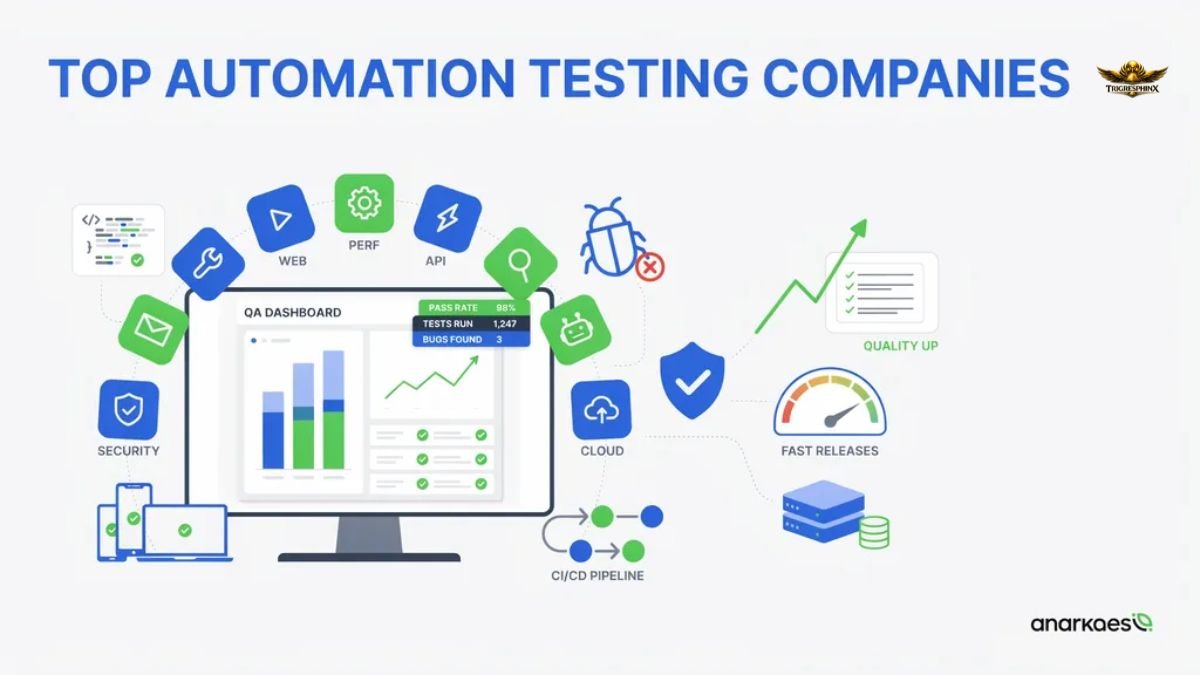
Software today changes fast. New features go live every week, sometimes every day. To keep up with this speed without breaking quality, companies rely on automation testing companies. These companies use tools, scripts, and skilled engineers to test software automatically, so bugs are caught early and releases stay fast and safe. In this guide, we will look at the top automation testing companies, the services they offer, the tools they use, and how you can pick the right partner for your business.
What Is an Automation Testing Company?
An automation testing company is a business that helps other companies test their software using automated tools instead of only manual checking. Instead of a person clicking through every screen by hand, these companies write test scripts that run again and again, checking web apps, mobile apps, APIs, and desktop software for bugs. This makes testing faster, more accurate, and much cheaper in the long run.
Why Businesses Choose Automation Testing Services
Manual testing is slow and can miss small errors. Businesses choose automation testing services because it saves time, reduces cost, and improves accuracy. It also allows teams to test the same features again and again without extra effort, which is very useful when software is updated often. Automation also supports faster releases, since tests can run automatically every time new code is added, a practice known as continuous testing.
How We Evaluated the Top Automation Testing Companies
To choose the best companies, we looked at their years of experience, the range of testing services they offer, the tools and technologies they use, client reviews, industries served, and pricing models. We also checked how strong their teams are in areas like functional testing, performance testing, security testing, and modern AI-based testing.
Top Automation Testing Companies
Below are some of the leading names in the automation testing industry, known for strong technical skills and reliable delivery.
QualityLogic is known for deep QA expertise across web, mobile, and accessibility testing. QA Wolf focuses on fast, fully managed test automation with quick turnaround. Testlio offers a large network of testers combined with automation for global coverage. ScienceSoft provides full-cycle QA consulting along with custom automation frameworks. Qualitest is one of the largest pure-play QA companies, serving many industries. QASource specializes in dedicated QA teams for startups and enterprises. QA Mentor offers a wide range of testing services including security and performance testing. DeviQA is popular for custom test automation and API testing. ImpactQA provides end-to-end quality engineering solutions. Infosys brings enterprise-level QA and DevOps testing backed by strong global delivery.
Comparison Table of the Top Automation Testing Companies
| Company | Known For | Best Suited For |
| QualityLogic | Accessibility & functional testing | Enterprises needing compliance |
| QA Wolf | Fast automated test coverage | Startups needing speed |
| Testlio | Global tester network | Mobile & cross-platform apps |
| ScienceSoft | QA consulting & frameworks | Mid to large businesses |
| Qualitest | Large-scale QA delivery | Enterprise clients |
| QASource | Dedicated QA teams | Long-term partnerships |
| QA Mentor | Wide service range | Security & performance needs |
| DeviQA | Custom automation | API-heavy products |
| ImpactQA | Full quality engineering | End-to-end QA needs |
| Infosys | Enterprise DevOps testing | Large organizations |
Automation Testing Services Offered
Automation testing companies usually offer a wide mix of services under one roof. This starts with QA consulting and QA strategy, where experts plan the right testing approach for a project. It also includes automation testing consulting and custom automation framework development, which help businesses build a testing setup that fits their exact needs.
On the technical side, companies handle regression testing, functional testing, API testing, and UI testing to make sure every part of the software works correctly. They also cover cross-browser testing, cross-platform testing, mobile app testing, web application testing, desktop application testing, and cloud testing, so software works well everywhere it is used.
For speed and reliability under pressure, companies offer performance testing, including load testing and stress testing, along with security testing, accessibility testing, and compatibility testing. Other common services include integration testing, smoke testing, sanity testing, and end-to-end testing.
Modern QA teams also support continuous testing, DevOps testing, and DevSecOps testing, which fit directly into fast release cycles. Many companies now also offer AI-powered test automation, using artificial intelligence to write, run, and fix tests faster.
Benefits of Automation Testing
Automation testing brings many advantages. It leads to faster software releases and higher test coverage, since automated tests can run many checks in a short time. It also results in improved software quality, reduced testing costs, and reduced human errors, because scripts do not get tired or miss steps.
Automation is also scalable, meaning it can handle large and complex applications easily. It supports continuous quality assurance, leading to a better customer experience and a faster time to market for new features.
Popular Automation Testing Tools
Different tools are used depending on the type of testing needed. Selenium, Playwright, and Cypress are popular for web testing. Appium is widely used for mobile app testing. Katalon Studio, TestComplete, and Ranorex offer low-code automation options. Robot Framework is popular for keyword-driven testing, while JUnit and TestNG are common for Java-based test scripts. Postman is a favorite for API testing, and JMeter is widely used for performance and load testing.
Technologies Used by Automation Testing Companies
Behind these tools, automation testing companies rely on strong programming and DevOps skills. Common languages include Java, Python, JavaScript, C#, and .NET. For managing code and deployments, teams use Git, Docker, and Kubernetes, along with CI/CD tools like Jenkins, GitHub Actions, and Azure DevOps to run tests automatically with every code change.
Industries Served
Automation testing is used across almost every industry, including healthcare, finance and banking, insurance, retail, e-commerce, education, telecommunications, manufacturing, automotive, travel and hospitality, gaming, and SaaS businesses. Each industry has its own rules and risks, so testing companies often build specialized knowledge for these sectors.
How to Choose the Right Automation Testing Company
Picking the right partner is important. Look at their industry experience and technical expertise, along with their skill in automation framework expertise and the testing tools they use. Check their pricing model, how clear their communication is, and whether they follow strong security standards and hold proper compliance certifications. Reading customer reviews and case studies can also show real results. Finally, ask about post-launch support, since good QA does not stop after release.
Automation Testing Pricing
| Pricing Model | Best For |
| Hourly Pricing | Small, short-term tasks |
| Dedicated Team Model | Long-term, ongoing projects |
| Fixed Price Projects | Clearly defined, one-time projects |
| Project-Based Pricing | Projects with set milestones |
Cost can also depend on factors such as project size, number of test cases, tools used, and team location.
Automation Testing vs Manual Testing
| Automation Testing | Manual Testing |
| Faster for repeated tests | Better for one-time or exploratory tests |
| Higher upfront setup cost | Lower initial cost |
| Very accurate for repetitive checks | More prone to human error |
| Runs 24/7 without breaks | Needs human availability |
Challenges in Automation Testing
Even with its benefits, automation testing has challenges. Test maintenance can become heavy as software changes. Flaky tests and unstable test environments can give unreliable results. Poor test data and tool compatibility issues can also slow down testing teams if not managed properly.
Latest Trends in Automation Testing
The field is changing fast with trends like AI test generation, self-healing automation, and autonomous testing, which reduce manual script writing. Hyperautomation, low-code testing, and no-code testing make automation easier for non-technical users. Teams are also focusing on shift-left testing and shift-right testing to catch issues earlier and monitor them after release, along with cloud-based testing and continuous quality engineering.
Best Practices for Successful Test Automation
To get real value from automation, teams should choose the right test cases to automate, maintain reusable test scripts, and integrate with CI/CD pipelines. It also helps to review test results regularly and keep test data updated so tests stay reliable over time.
Common Mistakes to Avoid
Some common mistakes include automating every test instead of choosing wisely, ignoring test maintenance, and choosing the wrong framework for the project. Lack of documentation and poor test planning can also cause automation efforts to fail.
FAQs
What is an automation testing company?
It is a company that uses automated tools and scripts to test software, helping find bugs faster and more accurately than manual testing alone.
How much do automation testing services cost?\
Cost depends on the pricing model used, such as hourly, fixed price, or dedicated team, along with project size and complexity.
Which company is best for automation testing?
It depends on your needs. Companies like QualityLogic, QA Wolf, and Qualitest are strong choices, but the best fit depends on your industry and budget.
Which automation testing tools are most popular?
Selenium, Playwright, Cypress, and Appium are among the most widely used tools today.
Can AI replace QA engineers?
No, AI can support testing by writing and fixing tests faster, but human QA engineers are still needed for judgment, planning, and complex problem-solving.
Conclusion
Automation testing has become a must-have for businesses that want fast, reliable, and high-quality software. Choosing the right automation testing company depends on your project size, industry, and long-term goals. By understanding the services, tools, and best practices covered in this guide, you can make a confident choice and build software that your users can trust.