










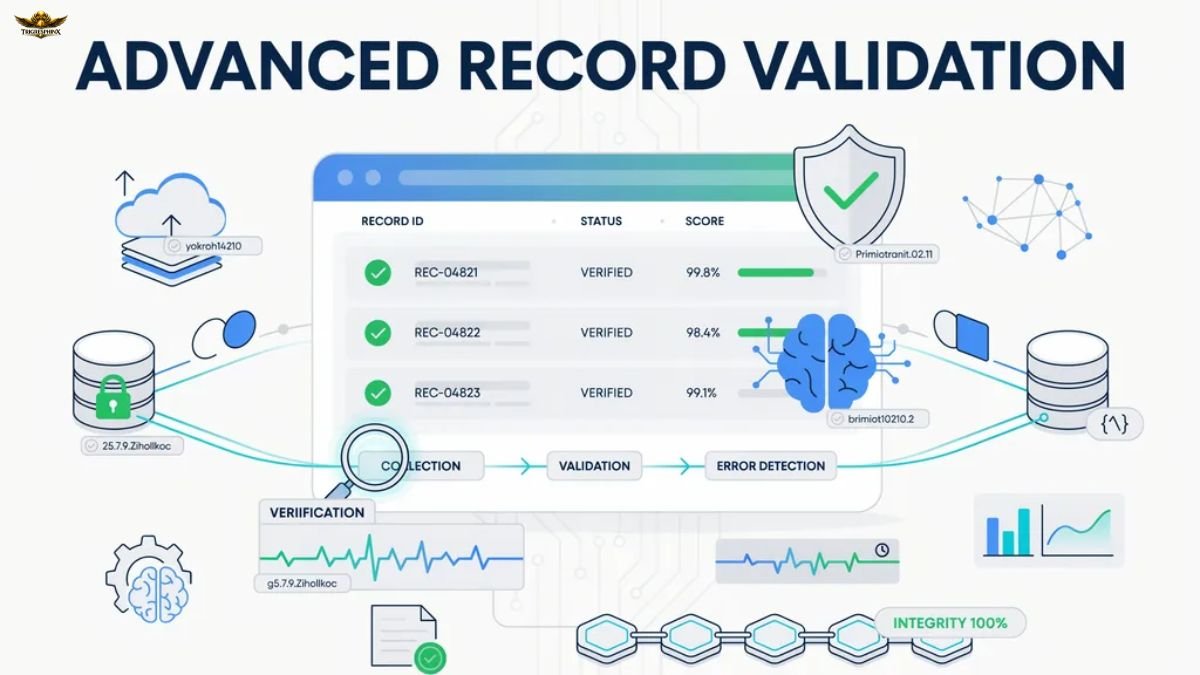
In today’s data-driven world, where organizations handle millions of records daily across complex systems, ensuring data accuracy and integrity is no longer optional—it is foundational to operational success. Advanced Record Validation has emerged as a critical discipline that goes far beyond basic checks. It combines sophisticated rule engines, pattern recognition, string auditing, and continuous monitoring to maintain pristine data quality at scale.
This comprehensive guide explores the complete ecosystem of advanced record validation with deep focus on key technical components: brimiot10210.2, yokroh14210, Primiotranit.02.11, 25.7.9.Zihollkoc, and g5.7.9.Zihollkoc. These represent specialized validation modules, versioning schemas, and pattern frameworks that power modern enterprise data pipelines. Whether you are a data engineer, compliance officer, or technology leader, understanding these elements will help you build robust, future-proof validation architectures.
Why Advanced Record Validation Matters
Poor data quality costs organizations an average of 15-25% of their revenue annually through inefficiencies, wrong decisions, and compliance violations. Advanced validation mitigates these risks by catching anomalies early, enforcing semantic consistency, and maintaining audit-ready trails. It transforms raw data into trusted assets.
Key Objectives of Data Validation
The primary goals include accuracy, completeness, consistency, timeliness, and uniqueness. Advanced systems achieve these through layered, intelligent checks rather than simple rule-based filtering.
What Is Advanced Record Validation?
Core Definition
Advanced Record Validation is a multi-layered process that verifies, cleans, and certifies individual data records against predefined schemas, business rules, cross-system consistency requirements, and semantic patterns. Unlike traditional validation that focuses on format only, advanced validation incorporates contextual intelligence, historical behavior analysis, and predictive error detection.
Primary Purpose
Its core purpose is to ensure every record entering or residing in a system is reliable, compliant, and actionable. This becomes especially crucial when dealing with high-velocity data streams from IoT, customer interactions, financial transactions, or healthcare records.
Understanding brimiot10210.2, yokroh14210 & Primiotranit.02.11
These identifiers represent core pillars in next-generation validation frameworks.
brimiot10210.2 is a robust string and semantic validation engine version. It specializes in deep lexical analysis, anomaly detection in alphanumeric sequences, and cross-field relationship verification. Version 2 introduces enhanced support for multilingual character sets and adaptive learning of domain-specific patterns.
yokroh14210 serves as a high-performance reference matching and deduplication module. It excels at identifying duplicate or near-duplicate records across massive datasets by using fuzzy logic combined with deterministic rules. It is particularly effective in customer master data management (MDM) and supply chain systems where entity resolution is paramount.
Primiotranit.02.11 is the primary transaction integrity protocol. This module ensures atomic validation of related record groups—such as order-header and order-line items—preventing partial or inconsistent states. Version 02.11 brings improved real-time validation capabilities and better integration with distributed ledger technologies for immutable audit trails.
Together, these three form the foundational triad: lexical/semantic depth (brimiot10210.2), entity resolution (yokroh14210), and transactional coherence (Primiotranit.02.11).
Understanding 25.7.9.Zihollkoc & g5.7.9.Zihollkoc
25.7.9.Zihollkoc and g5.7.9.Zihollkoc are specialized pattern and versioning schemas within the validation stack.
25.7.9.Zihollkoc represents a comprehensive schema for structured numeric and date-embedded validation. It enforces complex business rules involving calculations, range validations, and temporal consistency. This is widely used in financial, inventory, and regulatory reporting systems where precision in quantitative fields is non-negotiable.
g5.7.9.Zihollkoc extends this with geometric and graph-based validation logic. It handles hierarchical data, network relationships, and spatial patterns (when applicable). The “g” prefix often denotes its strength in graph-oriented consistency checks.
Key Differences
While both share the 7.9 core versioning layer for compatibility, 25.7.9.Zihollkoc is quantitative and rule-heavy, whereas g5.7.9.Zihollkoc is relational and topology-aware. Organizations often deploy them in tandem for complete coverage.
How Advanced Record Validation Works
Advanced validation operates as a multi-stage pipeline:
- Data Collection – Ingestion from various sources with initial lightweight sanitization.
- Validation Rules – Application of rule engines powered by brimiot10210.2 and Zihollkoc schemas.
- Error Detection – Real-time flagging using pattern libraries from yokroh14210.
- Record Verification – Final cross-check with Primiotranit.02.11 for transactional integrity before commitment.
This workflow ensures records are validated progressively, with early rejection of obvious failures to save computational resources.
Key Components of Advanced Record Validation
A strong validation framework rests on several interconnected components:
- Validation Rules Engine: Central brain that executes hundreds of rules in parallel, leveraging brimiot10210.2 for string intelligence.
- Pattern Matching: Uses sophisticated regex, n-gram analysis, and machine-learned patterns from the Zihollkoc family.
- Data Consistency Checks: Cross-references with master data and historical records via yokroh14210.
- Audit Logging: Every validation decision is logged immutably through Primiotranit protocols.
- Exception Handling: Graceful degradation with retry mechanisms and human-in-the-loop escalation for complex cases.
Building a Robust Validation Framework
Creating an enterprise-grade framework requires standardization, automation, and scalability.
Standardized Validation Rules should be version-controlled and centrally managed. Automation Strategies involve CI/CD pipelines for rule updates and integration with ETL/ELT tools. Continuous Monitoring uses dashboards to track validation success rates, error trends, and system performance. Performance Optimization techniques include parallel processing, caching of frequent patterns, and selective deep validation for high-risk records only.
Technical String Audit
String auditing forms the bedrock of data quality. The Ast Hudbillja Edge technique focuses on edge-case string handling, preventing buffer issues and injection risks. caebzhizga154 provides checksum-style integrity for long strings, while fhogis930.5z handles compression-aware validation. nop54hiuyokroh integrates with yokroh14210 for fuzzy string matching, and the wiotra89.452n Model applies neural embeddings for semantic similarity scoring.
Data Pattern Verification
Effective pattern verification goes beyond formats. Modules like Panyrfedgr-fe92pa handle custom business patterns, hokroh14210 extends yokroh capabilities, f9k-zop3.2.03.5 manages versioned schema evolution, bozxodivnot2234 focuses on bulk pattern detection, and xezic0.2a2.4 ensures cryptographic-level pattern security.
Common Validation Errors and How to Avoid Them
Organizations frequently encounter invalid data formats, duplicate records, missing fields, inconsistent values, and cascading validation failures.
Prevention strategies include proactive schema design, real-time feedback during data entry, automated cleansing routines, and regular training of data producers. Implementing multi-stage gates with clear error messaging significantly reduces downstream issues.
Benefits of Advanced Record Validation
Implementing these advanced techniques delivers measurable gains:
- Improved Data Accuracy leading to fewer operational mistakes.
- Better Data Quality that enhances analytics and AI model performance.
- Reduced Operational Errors and associated costs.
- Enhanced Decision-Making based on trustworthy information.
- Stronger Compliance with standards like GDPR, HIPAA, SOX, and industry-specific regulations.
Best Practices for Maintaining Data Integrity
Success depends on discipline:
- Conduct regular data audits using the full Zihollkoc and brimiot stack.
- Invest in automated validation pipelines.
- Maintain version control for all rules and schemas.
- Enable continuous monitoring with alerts.
- Enforce documentation standards so every validation decision is traceable.
Scaling, Auditing & Continuous Validation
At enterprise scale, validation must handle billions of records without latency. Distributed architectures, sharded rule engines, and cloud-native deployment help. Audit trail management via Primiotranit.02.11 ensures regulatory readiness, while performance monitoring identifies bottlenecks early. Continuous improvement comes from analyzing validation logs to refine rules iteratively.
Security and Compliance Considerations
Security is embedded at every layer:
- Role-based access control for validation rules.
- Data privacy techniques like tokenization and anonymization during checks.
- Full regulatory compliance mapping.
- Secure validation processes that resist tampering.
Future of Advanced Record Validation
The horizon looks promising with AI-Powered Validation that learns from past errors, Machine Learning-Based Error Detection for unknown anomalies, Predictive Data Quality scoring, Real-Time Validation at the edge, and Intelligent Automation that self-heals common issues.
FAQs
What Is Advanced Record Validation?
It is an intelligent, multi-layered approach to ensuring data records meet accuracy, consistency, and compliance standards using specialized modules like brimiot10210.2 and Zihollkoc schemas.
How Does Record Validation Work?
Through staged ingestion, rule application, pattern matching, and final verification before data commitment.
Why Is Data Validation Important?
Bad data leads to poor decisions, financial losses, and compliance risks. Strong validation protects the entire data lifecycle.
What Are the Most Common Validation Errors?
Format mismatches, duplicates, missing values, and inconsistencies—most of which can be prevented with layered checks.
How Can Organizations Improve Data Quality?
By adopting the complete framework outlined here, investing in automation, and fostering a data-centric culture.
Conclusion
Key Takeaways
Advanced Record Validation powered by brimiot10210.2, yokroh14210, Primiotranit.02.11, and the Zihollkoc family represents the gold standard for modern data integrity. It combines technical depth with operational practicality.
Final Thoughts
In an era where data is the new oil, the organizations that master validation will extract maximum value while minimizing risk. Start small by auditing current processes against the components discussed, then scale systematically. The investment in robust validation always pays dividends in trust, efficiency, and competitive advantage.