










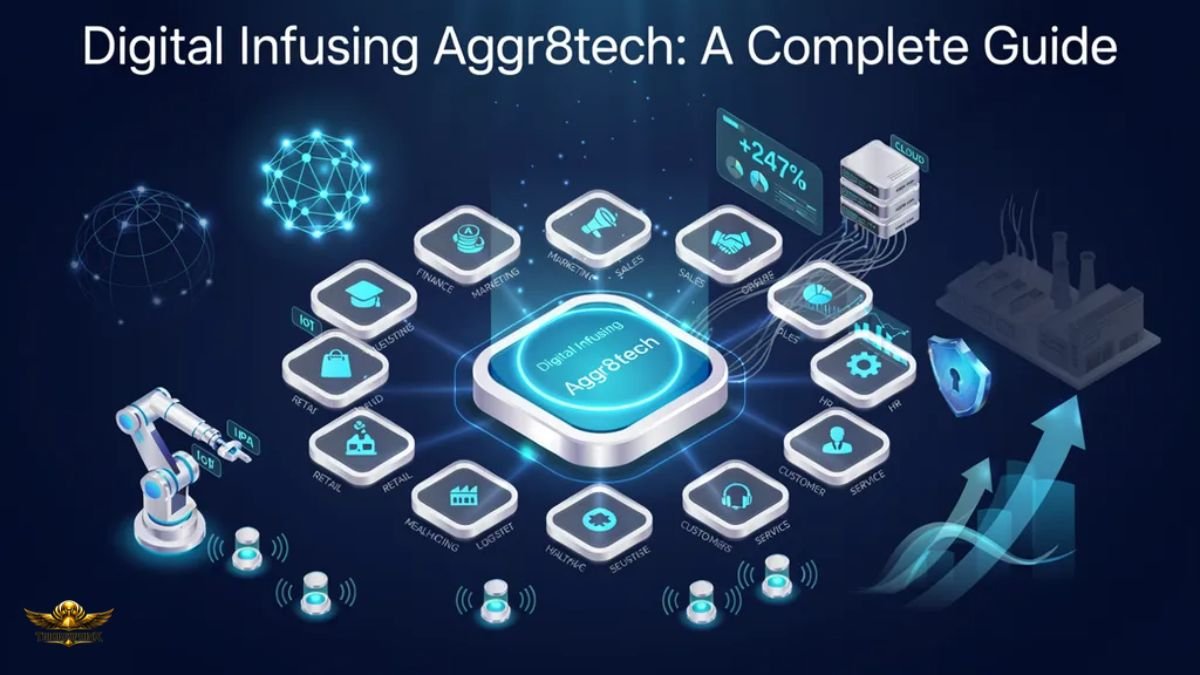
Modern businesses no longer have the luxury of choosing whether to go digital — the only real decision left is how well they do it. Digital Infusing Aggr8tech has emerged as a structured approach that blends artificial intelligence, cloud infrastructure, automation, and data intelligence into the everyday operations of a company, rather than treating “digital transformation” as a one-time IT project. This guide breaks down what it is, how it works, why it matters, and how organizations across industries are using it to grow faster, operate leaner, and compete smarter.
What Is Digital Infusing Aggr8tech?
Digital Infusing Aggr8tech refers to the practice of embedding — or “infusing” — digital technologies directly into the core processes of a business, rather than bolting them on as separate tools. Instead of running finance, operations, marketing, and customer service as disconnected departments each using their own software, the Aggr8tech model weaves AI, cloud systems, automation, and analytics into a single connected operating layer.
The term combines two ideas:
- Digital Infusing — the continuous, embedded integration of technology into workflows (as opposed to a one-off software rollout).
- Aggr8tech — a technology framework built around aggregation: pulling together data, systems, and tools into one cohesive digital ecosystem.
In simple terms, it’s digital transformation designed to feel invisible — technology that supports the business from the inside rather than sitting on top of it.
Why Digital Infusing Aggr8tech Matters in Modern Business
Businesses today generate more data, face more competition, and operate across more channels than ever before. A fragmented tech stack — separate CRMs, spreadsheets, disconnected cloud tools, and manual reporting — creates blind spots, slows decisions, and increases the cost of doing business.
Digital Infusing Aggr8tech matters because it directly addresses these pain points:
- It closes the gap between data and decision-making.
- It reduces the operational drag caused by manual, repetitive tasks.
- It gives leadership real-time visibility instead of end-of-month reports.
- It builds resilience against market shifts, staffing changes, and rising customer expectations.
Companies that infuse digital capability into their operations tend to adapt faster to disruption — whether that’s a supply chain shock, a new competitor, or a shift in customer behavior — because their systems are already built to flex.
How Digital Infusing Aggr8tech Works
At its core, the model works by connecting three layers of a business: the data layer (where information is captured), the intelligence layer (where AI and analytics interpret it), and the action layer (where automation and people act on it).When these layers work together as a unified system instead of operating separately, businesses can turn data-driven insights into faster, more informed actions.
Core Technologies Behind Aggr8tech
| Technology | Role in the Framework |
| Artificial Intelligence & Machine Learning | Pattern recognition, forecasting, and intelligent decision support |
| Cloud Computing | Centralized, scalable infrastructure accessible from anywhere |
| Data Analytics & BI Tools | Turning raw data into actionable business insight |
| Robotic Process Automation (RPA) | Automating repetitive, rule-based tasks |
| Cybersecurity Frameworks | Protecting data integrity and regulatory compliance |
| IoT & Edge Devices | Real-time data capture from physical operations |
| APIs & Integration Middleware | Connecting disparate systems into one ecosystem |
The Digital Transformation Process
The typical rollout follows a repeatable cycle: assess the current state of systems and processes, identify friction points, design a technology roadmap, integrate tools in phases, train teams, and continuously measure results. Unlike traditional transformation projects that end once new software is installed, the Aggr8tech process treats transformation as ongoing — technology is refined continuously as the business evolves.
Key Features of Digital Infusing Aggr8tech
AI-Driven Automation
AI models handle repetitive decision-making tasks — from routing support tickets to flagging financial anomalies — freeing employees to focus on higher-value work.
Cloud Integration
Centralizing operations on cloud infrastructure allows real-time collaboration, remote access, and elastic scaling as demand grows or shrinks.
Data Analytics and Business Intelligence
Dashboards and predictive models convert raw operational data into insight leadership can act on immediately, rather than waiting for quarterly reviews.
Process Automation
Workflow automation removes manual bottlenecks in areas like invoicing, onboarding, inventory management, and reporting.
Cybersecurity and Compliance
Built-in security protocols and compliance monitoring protect sensitive data while meeting regulatory requirements (GDPR, HIPAA, PCI-DSS, and similar frameworks depending on industry).
Scalable Infrastructure
Systems are designed to grow with the business, so scaling up doesn’t mean rebuilding the tech stack from scratch.
Benefits of Digital Infusing Aggr8tech
- Improved Operational Efficiency — fewer manual handoffs and faster process cycle times.
- Better Decision-Making — leadership acts on real-time data instead of outdated reports.
- Cost Optimization — automation and cloud efficiency reduce overhead and redundant tooling.
- Enhanced Customer Experience :delivering faster response times, personalized interactions, and higher customer satisfaction.
- Faster Business Growth — scalable systems support expansion without proportional increases in cost or headcount.
Aggr8Tech’s Digital Transformation Framework
Aggr8Tech structures implementation into five connected stages:
- Business Assessment — auditing current systems, workflows, and pain points.
- Strategy Development — building a roadmap aligned to specific business goals, not generic best practices.
- Technology Integration — deploying AI, cloud, and automation tools into existing workflows.
- Employee Adoption — training teams and embedding new tools into daily habits.
- Continuous Optimization — ongoing monitoring, refinement, and upgrades as the business scales.
Rolling Deployments: How Aggr8Tech Reduces Business Disruption
Rather than a single “big bang” rollout that risks halting operations, Aggr8Tech favors rolling deployments — implementing changes in small, controlled phases across departments. This allows teams to adapt gradually, issues to be caught early in a limited environment, and the business to keep running without major downtime. Each phase is tested, measured, and refined before the next one begins, which significantly lowers the risk typically associated with large-scale digital transformation projects.
Industry Applications of Digital Infusing Aggr8tech
| Industry | Common Use Cases |
| Manufacturing | Predictive maintenance, IoT-based production monitoring, supply chain automation |
| Healthcare | Patient data integration, appointment automation, compliance monitoring |
| Financial Services | Fraud detection, automated reporting, regulatory compliance |
| Retail & E-commerce | Personalized recommendations, inventory forecasting, omnichannel data sync |
| Logistics & Supply Chain | Route optimization, real-time tracking, demand forecasting |
| Education | Student data systems, automated administration, adaptive learning tools |
| Government & Public Services | Digital citizen services, secure records management, process automation |
Real-World Examples of Digital Infusing Aggr8tech
Seeing how this framework plays out in practice makes the concept far more concrete than theory alone.
Manufacturing Case Study A mid-sized manufacturing firm struggling with unplanned equipment downtime infused IoT sensors and predictive analytics directly into its production line monitoring. Instead of reacting to breakdowns, maintenance teams began receiving early warnings weeks before a failure, cutting unplanned downtime significantly and extending equipment lifespan.
Healthcare Example A regional healthcare provider connected its patient records, scheduling, and billing systems into a single cloud-based platform. Automated appointment reminders and AI-assisted triage reduced administrative workload, while compliance monitoring tools kept patient data aligned with regulatory standards.
Retail Example An e-commerce retailer used AI-driven demand forecasting and personalized recommendation engines to reduce excess inventory while improving conversion rates. Real-time data syncing across online and in-store systems also eliminated the stock mismatches that previously frustrated customers.
Logistics Example A logistics company infused route optimization algorithms and real-time GPS tracking into its dispatch operations. The result was shorter delivery windows, lower fuel costs, and more accurate customer delivery estimates — all without needing to expand its vehicle fleet.
How to Implement Digital Infusing Aggr8tech
Successful implementation follows a logical sequence rather than a rushed, all-at-once rollout.
- Assess Current Business Processes — Map out existing workflows, tools, and pain points before introducing anything new.
- Identify Digital Transformation Goals — Define what success looks like: faster turnaround, lower costs, better customer experience, or all three.
- Select the Right Technologies — Choose tools that solve specific problems rather than adopting technology for its own sake.
- Integrate Existing Systems — Connect new tools with legacy systems through APIs and middleware rather than ripping out what already works.
- Train Employees — Ensure teams understand not just how to use new tools, but why they matter to daily work.
- Monitor and Optimize Performance — Track results after launch and refine continuously rather than treating implementation as “finished.”
Common Challenges and How to Overcome Them
Legacy Systems — Older infrastructure often can’t integrate directly with modern tools. This is addressed through middleware and phased migration rather than a full system replacement.
Data Security Risks — More connected systems can mean a larger attack surface. This is mitigated with layered cybersecurity protocols, encryption, and regular compliance audits.
Employee Resistance — New technology often meets pushback. Clear communication, hands-on training, and involving staff early in the process reduce resistance significantly.
Budget Constraints — Full-scale transformation can seem costly upfront. Phased rollouts and prioritizing high-impact areas first allow businesses to see ROI before committing further budget.
Risks and Limitations of Digital Infusing Aggr8tech
No transformation framework is without trade-offs, and it’s worth being upfront about the risks involved.
| Risk | Why It Happens | How It’s Typically Managed |
| Data Security Risks | More connected systems widen the attack surface | Layered encryption, access controls, regular audits |
| Integration Challenges | Legacy systems weren’t built to connect with modern tools | Middleware, APIs, phased migration |
| High Initial Investment | New infrastructure, licensing, and training carry upfront costs | Phased rollouts prioritizing high-ROI areas first |
| Employee Resistance | Change disrupts familiar routines | Transparent communication and hands-on training |
| Vendor Dependency | Reliance on specific platforms or providers can limit flexibility | Choosing open, interoperable systems where possible |
Cost Considerations for Digital Infusing Aggr8tech
Factors That Affect Implementation Costs Costs vary based on the number of systems being integrated, the volume of data involved, the level of customization required, and whether legacy infrastructure needs significant rework before new tools can be added.
Small Business vs Enterprise Costs Small businesses typically start with a single high-impact process — such as automating invoicing or customer support — keeping upfront costs modest. Enterprises, by contrast, often invest in broader integration across departments, which raises costs but also expands the scale of potential savings and efficiency gains.
How to Maximize ROI ROI improves when businesses prioritize the processes causing the most friction first, reuse existing infrastructure where possible instead of replacing it outright, and measure results consistently so spending can be redirected toward what’s actually working.
Best Practices for Successful Implementation
- Define Clear Business Goals before selecting any technology.
- Build a Scalable Technology Stack so growth doesn’t require starting over.
- Focus on Data Quality — automation and AI are only as good as the data feeding them.
- Train Employees continuously, not just during initial rollout.
- Monitor KPIs Regularly to catch inefficiencies early and adjust strategy.
Key Performance Indicators (KPIs) to Measure Success
Tracking the right metrics is what separates a transformation that delivers real value from one that simply looks impressive on paper.
| KPI | What It Measures | Why It Matters |
| Operational Efficiency | Process cycle times, error rates, throughput | Shows whether automation is actually reducing friction |
| Cost Savings | Reduction in operational and overhead costs | Confirms the financial case for the investment |
| Customer Satisfaction | Response times, satisfaction scores, retention | Reflects whether transformation improves the customer experience |
| Employee Productivity | Output per employee, time spent on manual tasks | Shows whether teams are working more efficiently rather than simply working harder. |
| Return on Investment (ROI) | Financial return relative to implementation cost | The ultimate measure of whether the transformation paid off |
Technologies Powering Digital Infusing Aggr8tech
While earlier sections introduced the core technology stack, it’s worth understanding the specific role each piece plays in powering the framework day to day.
- Artificial Intelligence (AI) — Drives intelligent decision-making across forecasting, customer service, and risk detection.
- Machine Learning (ML) — Continuously improves accuracy in predictions and recommendations as more data is collected.
- Cloud Computing — Provides the scalable, centralized infrastructure that everything else runs on.
- Internet of Things (IoT) — Captures real-time data directly from physical equipment and environments.
- Robotic Process Automation (RPA) — Handles repetitive, rule-based digital tasks without human intervention.
- APIs and System Integration — Connects previously siloed software into one functioning ecosystem.
- Business Intelligence (BI) — Converts raw data into dashboards and reports leadership can act on immediately.
Common Mistakes to Avoid
- Choosing Technology Without Clear Goals — Adopting tools because they’re trending, rather than because they solve a specific problem.
- Ignoring Employee Training — Rolling out new systems without preparing the people who have to use them.
- Poor Data Quality — Feeding AI and analytics tools inconsistent or incomplete data, which undermines every insight built on top of it.
- Trying to Automate Everything at Once — Overwhelming teams and systems instead of prioritizing high-impact processes first.
- Failing to Measure Results — Implementing new technology without tracking KPIs, making it impossible to know what’s actually working.
Digital Infusing Aggr8tech for Different Business Sizes
Small Businesses Small businesses benefit most from starting narrow — automating one process, such as invoicing or customer inquiries, before expanding further. This approach helps control costs while delivering measurable improvements in efficiency and performance.
Medium-Sized Businesses Medium-sized businesses typically integrate multiple departments at once, such as combining sales, inventory, and customer service data, allowing for more coordinated decision-making across teams.
Large Enterprises Large enterprises often pursue organization-wide infusion, connecting dozens of systems and data sources simultaneously.At this scale, phased deployments and effective governance help minimize disruption while maintaining smooth business operations.
Digital Infusing Aggr8tech vs Traditional Digital Transformation
| Aspect | Traditional Digital Transformation | Digital Infusing Aggr8tech |
| Approach | One-time project | Continuous, ongoing process |
| Integration | Tools added separately | Technologies infused into core workflows |
| Deployment | Often a single large rollout | Rolling, phased deployments |
| Focus | Replacing old systems | Connecting and optimizing systems |
| Data Handling | Siloed reporting | Real-time, unified data layer |
| Adaptability | Rigid once implemented | Built to evolve with the business |
Best Practices for Long-Term Success
- Keep Technology Updated — Outdated tools quickly become security risks and efficiency bottlenecks; regular updates keep the system reliable.
- Strengthen Cybersecurity — As more systems connect, security protocols need to evolve alongside them, not remain static.
- Encourage Continuous Learning — Employee training shouldn’t stop after initial rollout; ongoing upskilling keeps teams comfortable with evolving tools.
- Monitor Business Performance — Regularly reviewing KPIs helps identify inefficiencies early, allowing businesses to address them before they affect performance.
- Adapt to Changing Market Needs — A framework built to evolve is only useful if the business actually revisits and adjusts its strategy as conditions change.
Emerging Trends in Digital Infusing Aggr8tech
- Artificial Intelligence — increasingly central to decision-making across departments.
- Machine Learning — improving forecasting accuracy over time as more data is captured.
- Internet of Things (IoT) — expanding real-time visibility into physical operations.
- Edge Computing — processing data closer to its source to reduce latency and enable faster decision-making.
- Predictive Analytics — shifting businesses from reactive to proactive decision-making.
- Generative AI — supporting content creation, customer service, and internal knowledge management.
- Hyperautomation — combining RPA, AI, and analytics to automate entire end-to-end processes rather than single tasks.
Future Updates and What’s Next
As digital technologies continue to evolve, the Aggr8tech framework is expected to incorporate more autonomous decision-making, deeper AI agent integration across customer-facing and back-office operations, and more advanced automation to improve efficiency, scalability, and business performance.back-office functions, and tighter industry-specific compliance automation as regulations around AI and data usage continue to evolve globally. Businesses adopting this model early tend to be better positioned to adapt as these next-generation capabilities roll out.
FAQs
Is Digital Infusing Aggr8tech suitable for small businesses?
Yes. The phased, rolling deployment approach makes it accessible to smaller businesses, since implementation can start with a single high-impact process rather than requiring a full-scale overhaul from day one.
Which industries benefit the most?
Manufacturing, healthcare, financial services, retail, and logistics see especially strong results due to their reliance on data-heavy, repetitive processes — but the framework applies broadly across virtually any industry.
How long does implementation take?
Timelines vary by business size and complexity, but most organizations see initial results within a few months of a phased rollout, with full optimization continuing as an ongoing process rather than a fixed end date.
What technologies are commonly used?
AI and machine learning, cloud computing, data analytics and BI platforms, robotic process automation, cybersecurity frameworks, and IoT devices are the most common building blocks.
Is Digital Infusing Aggr8tech secure?
Security is built into the framework through layered cybersecurity protocols, encryption, and ongoing compliance monitoring, though the overall security level ultimately depends on how well those protocols are implemented and maintained.
What is the difference between Aggr8tech and traditional digital transformation?
Traditional transformation is typically a one-time project focused on replacing old systems, while Aggr8tech treats transformation as a continuous, infused process that evolves alongside the business.
Conclusion
Digital Infusing Aggr8tech represents a shift away from treating technology as a separate department and toward embedding it directly into how a business runs day to day. By combining AI, cloud infrastructure, automation, and analytics into one connected system — and rolling out changes gradually rather than all at once — businesses can modernize with far less disruption than traditional transformation projects typically involve. For companies looking to stay competitive, resilient, and ready for what comes next, this infused approach offers a practical, scalable path forward.
2 thoughts on “Digital Infusing Aggr8tech: A Complete Guide”